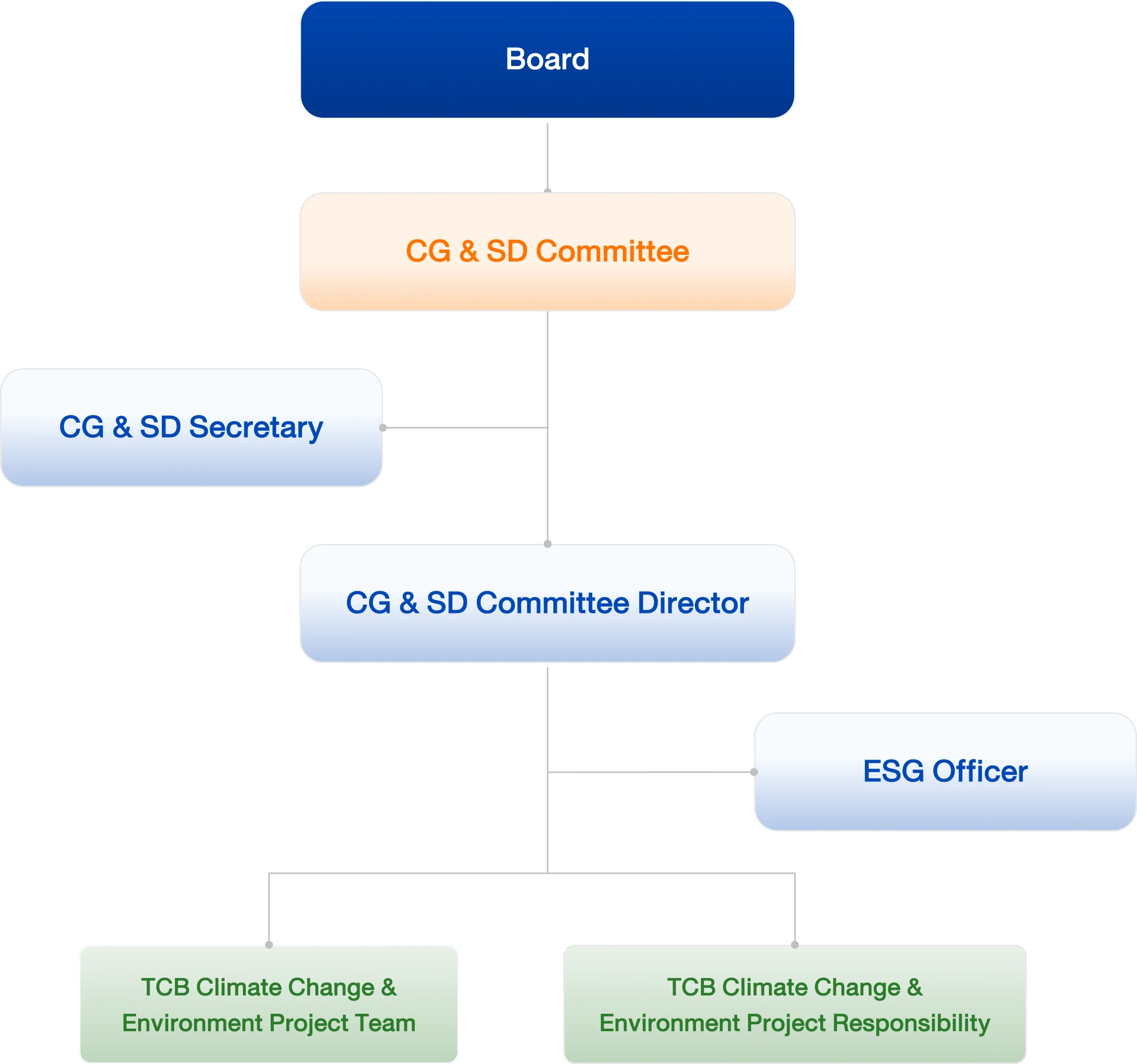

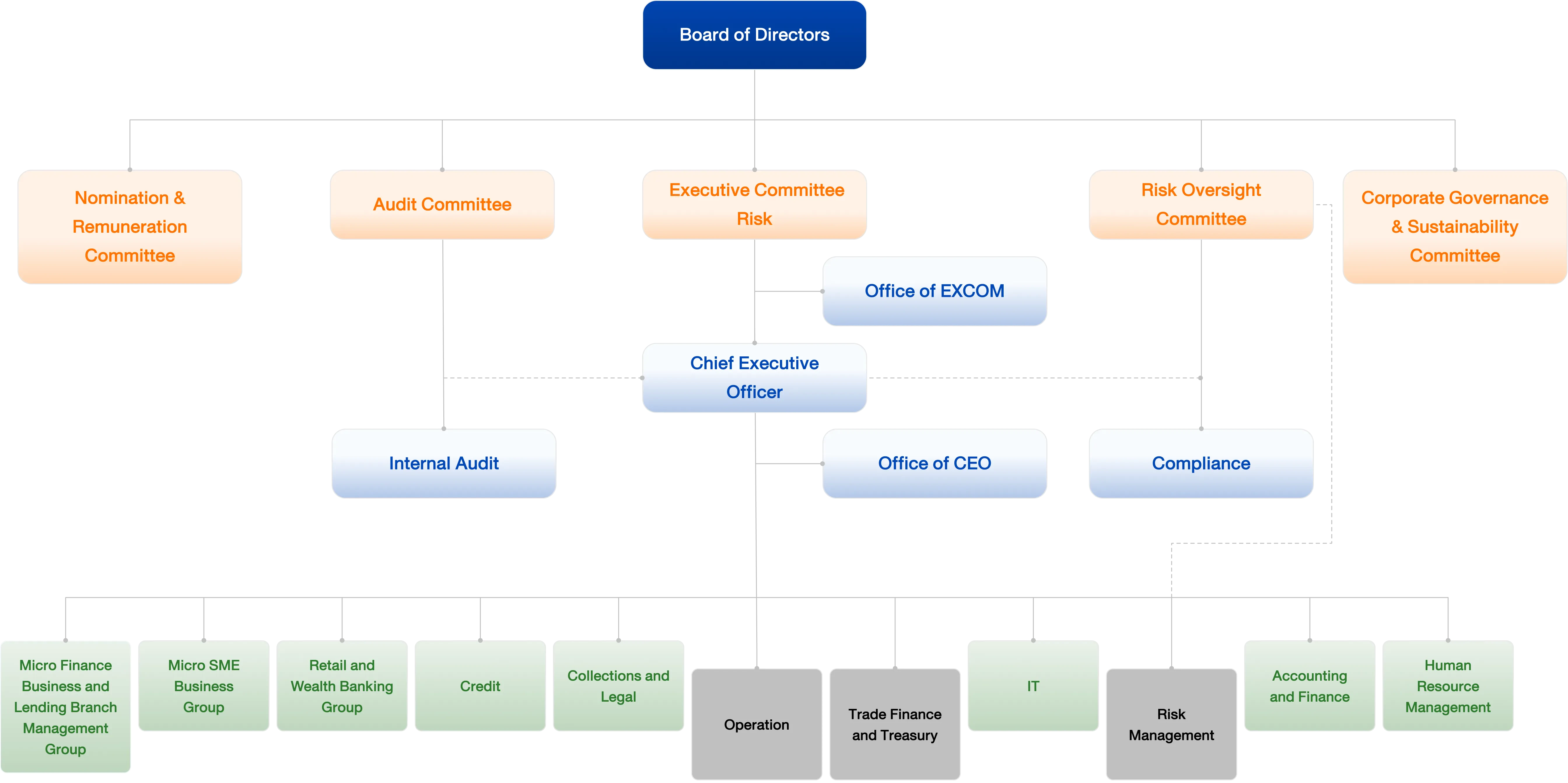
Sustainability Governance Structure

Sustainable Development Management Structure
The Bank assigned the Corporate Governance and Sustainable Development Committee is responsible for recommending the practice guideline and advising the Board of Directors on matters related to good corporate governance and sustainable development, which the meeting is held quarterly to determine the scope, policies and practice guideline, as well as to monitor the performance and report to the Board of Directors.
 means an executive as defined in the Notification of the Securities and Exchange Commission that the SEC Koh Joh 17/2551 Re: Definition of Announcement on Issuance and Offering of Securities (as amended)
Thai Credit Bank Public Company Limited is committed to integrating environmental and climate change considerations into the Bank’s business strategy, risk management framework, and financial product development, in alignment with the regulatory guidance of the Bank of Thailand (BOT). The Bank applies the proportional risk management principle, which is adapted to the Bank’s size, complexity, and level of environmental risk exposure, while supporting Thailand’s national carbon neutrality targets.
Proportional Risk Principle
The proportional risk principle means that the Bank should implement climate-related risk management measures that are appropriate to the Bank’s organizational size, business complexity, and level of environmental risk exposure. This approach does not apply a “one-size-fits-all” model but instead designs strategies that align with the Bank’s specific context.
This principle is established to:
- Enable the Bank to implement climate risk management practices in accordance with regulatory guidance without creating unnecessary operational impacts or undue burden.
- Enhance efficiency by focusing controls on material issues.
Environmental and Climate Change Targets
- Establish a Climate Change Management Committee in 2025.
- Integrate climate-related risks into governance, business strategy, and internal decision-making processes by 2026.
- Support Thailand’s national targets by setting the Bank’s carbon neutrality target by 2050 and net-zero greenhouse gas emissions target by 2065.
- Promote green finance to support customers in transitioning to a low-carbon economy, starting in 2026.
- Implement effective climate-related risk management beginning in 2026.
- Align with international sustainability standards such as TCFD, UNPRB, and Basel Committee principles starting in 2026.
The Bank established a climate change governance structure on 29 July 2025.