

Materiality Assessment

Defining and Evaluating Material Sustainability Issues
To ensure that the Bank's environmental, social/employee and governance/economic operations achieve Sustainable Development Goals and respond appropriately to stakeholders.
The Bank has identified and prioritized the materiality sustainability issues that may affect the Bank's business operations and stakeholders from internal and external factors to comply with the Global Reporting Initiative (GRI), to ensure effective sustainability operations. The process of determining and considering important sustainability issues that affect businesses and stakeholders throughout the value chain is as follows.

1. Identifying material sustainability issues
Gathering important sustainability issues in each dimension, both external and internal, that are linked to the Bank's business operations and strategic direction, such as global sustainability trends. National and global sustainability requirements and frameworks, as well as risks and opportunities that may arise and are likely to affect business operations, create common value, and meet the expectations of all stakeholder groups, and the collected topics will be proposed and considered by the relevant committees.

2. Prioritization and Assessment of Sustainability Issues
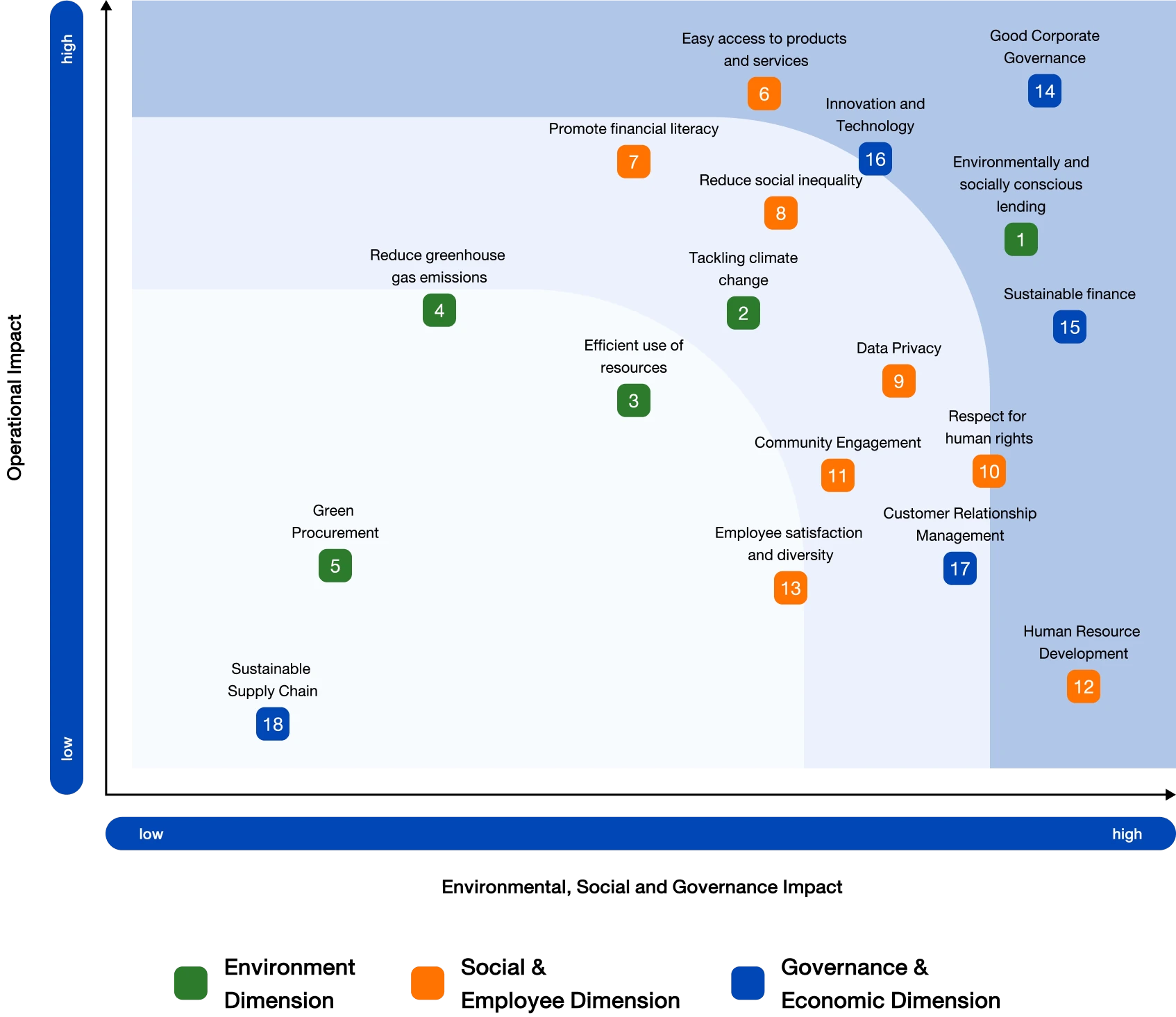
To analyse and consider issues that are important to the organization and stakeholders in two dimensions; expectations or the issues that can impact on operations and the impact on the Bank's main stakeholders, including employees, customers, business partners, communities and society, and government agencies.The Bank has divided the management of sustainability issues into three levels; Significant Level, Moderate Level, and Fundamental Level, to provide information that reflects operational goals and provides guidelines for managing sustainability issues most effectively.
3. Consideration and Examination of Material Sustainability Issues
Report to the Corporate Governance and Sustainable Development Committee to consider the appropriate process and the prioritization results in various factors. The results of the assessment of key sustainability issues will be considered and approved by the Committee to determine the strategy, goals, and sustainability activities in the short, medium, and long term, the comprehensiveness of information disclosure, and the verification of completeness based on the principle of completeness as well as assign relevant agencies to formulate guidelines and comply with the appropriateness.
4. Review and Communication of Material Sustainability Issues
To present the results of the assessment of key sustainability issues to relevant stakeholders through various channels, as well as listen to opinions and suggestions from stakeholders through various channels to improve the Bank's sustainability operations and disclosure to reflect the expectations of real stakeholders, keeping up with changes in various sustainability requirements and frameworks that are likely to affect business operations, as well as make the content more effective in the next report.
In 2024, the Bank identified a total of 18 important sustainability topics, covering all 3 dimensions: environmental, society/employee, and governance/economy as follows:

-
1Environmentally and socially conscious lending
-
2Tackling climate change
-
3Efficient use of resources
-
4Reduce greenhouse gas emissions
-
5Green Procurement

-
6Easy access to products and services
-
7Promote financial literacy
-
8Reduce social inequality.
-
9Data Privacy
-
10Respect for human rights
-
11Community Engagement
-
12Human Resource Development
-
13Employee satisfaction and diversity

-
14Good Corporate Governance
-
15Sustainable finance
-
16Innovation and Technology
-
17Customer Relationship Management
-
18Sustainable Supply Chain


The Bank has become a member of various organizations or units established for the benefit of the environment, society/employees, and governance/economy, such as the Thai Bankers Association and companies that have expressed their intentions to combat corruption with The Thai Private Sector Action Coalition to develop knowledge to drive within the organization as well as to be a part of helping the economy, society and improve the quality of life of the population sustainability.