


Thai Credit's Value Chain and Stakeholder Engagement
Sustainability Development of Thai Credit Bank
Thai Credit's Value Chain
The Bank's Executive Committee, Management, and Employees at all levels are committed to operating sustainable banking responsibly, under the principles of good governance to helps lead to the sustainable development of customers, business stakeholders, and the country as a whole.
The focus is on managing the sustainability of activities throughout the value chain of the business from upstream to downstream by building stability with products and services that meet the needs of all stakeholders along with effective risk management.

 Design, Product Development and Innovation
The Bank has continuously designed and developed financial products to create long-term business growth. The goal is to ensure that everyone has fair and equitable access to financial services. To ensure that customers have a sustainable and healthy financial life.
Throughout the past period, the Bank has focused on developing financial products and services that are in line with the needs of the business sector and the general public. In addition, they are aware of the importance of being a part of building economic stability for Thailand.
- Sustainable Procurement
- Create and develop financial products , new financial services and solutions tailored to customers’ needs.
- Creating a positive attitude and delivering knowledge to customers.
 Sales Marketing and Credit Analysis
The Bank analyzes and develops financial products to meet a variety of customer needs, as well as to develop a fast service process. The loan approval system is not complicated, and the Bank always maintains a good relationship with customers by understanding the needs of all target customers. As a result, customers are confident in the quality and satisfaction of using the Bank's credit services or financial and investment products.
In addition, as a commercial bank that plays an important role in raising capital and allocating resources in the economy, the Bank has a responsibility to contribute to the country's security through environmental and social screening and assessment. This is to support customer growth and generate long-term returns, as well as reduce negative environmental and social impacts.
- Define ESMS Policy (Environmental and Social Management System)
- Environmental and Social Screening and Assessment (ESDD)
- Promote financial services and expand the customer base, including customer groups who unable to access to financial services in the system.
- Increase efficiency and develop solutions for resource utilization
 Operations, Transactions, and Compliance
The Bank has established a Service Channels Policy to enable the Bank to manage its service channels and customer services in a fair manner, to manage risks and take care of customers in a comprehensive and appropriate manner, as well as to define the roles, duties and responsibilities of executives and employees who perform their duties related to the Bank's customer service through various service channels to ensure that the risk management process related to customer service channels is efficient, concise and appropriate, in accordance with the situation and technology used in customer service.
The Bank focuses on expanding its financial services branches through the form of deposit branches and lending branches to cover the entire region of the country.
- Efficient and sustainable business operations and processes
 Payment and Billing
The Bank has a policy of monitoring and accelerating debts so that debts can be resolved quickly and promptly when customers encounter problems. This allows the bank to receive the highest debt repayment. It can reduce the debt classification and reserve setting of the bank as a way to prevent debt arrears that cause damage to the bank. To create a good experience for customers and to enable customers to continue their business.
In addition, the Bank has arranged for ethical debt collection monitoring in strict accordance with the BOT's guidelines, with close supervision of debt collection behavior of collection agency officials and debt collection.
- Sustainable products and services that meet the needs of consumers
- Deliver the experience To facilitate transactions for customers.
 Service and Customer Relationship Building
The Bank has always attached great importance to maintaining good relationships with customers. The company has established a customer relationship management team and a call center to meet the needs of all target customer groups, including developing products and services that can effectively meet customer needs to provide a positive customer experience continuously.
At the same time, the Bank has also publicized the Bank's financial product information through various channels so that the Bank's customers can access financial products comprehensively.
In addition, the Bank regularly supports and encourages all customers and the community to acquire financial knowledge and discipline. Through providing financial knowledge suitable for customers in each target group. This includes providing accurate information about financial services to support customers' businesses to grow steadily together with the Bank through the "Tang To Know-how" project.
- Taking care of the development of the services through providing excellent service.
- Building and maintaining strong relationships with customers
- Measures to provide timely and helpful assistance to customers with problems to the best of their ability.
- Increasing customer satisfaction

Stakeholder Engagement
The Bank attaches great importance to the management and operation of the business with integrity, transparency, and fairness, which is in line with the principles of good corporate governance throughout the business growth route. The survey was conducted to analyse and prioritize stakeholder groups, both internal and external, throughout the business value chain to ensure that it meets the expectations of the Bank's stakeholders appropriately as well as concerning participation, opening various communication channels such as organizing the Annual General Meeting of Shareholders, customer satisfaction surveying, complaint channels organizing activities to increase employee satisfaction, etc. To listen to the needs and expectations of stakeholders for business operations and apply suggestions to review the appropriateness of the Bank's policies and related guidelines regularly. For the benefit of all stakeholder groups, there is a review of the needs and expectations of stakeholders once a year. In 2024, the Bank classified stakeholders into 7 groups as follows:
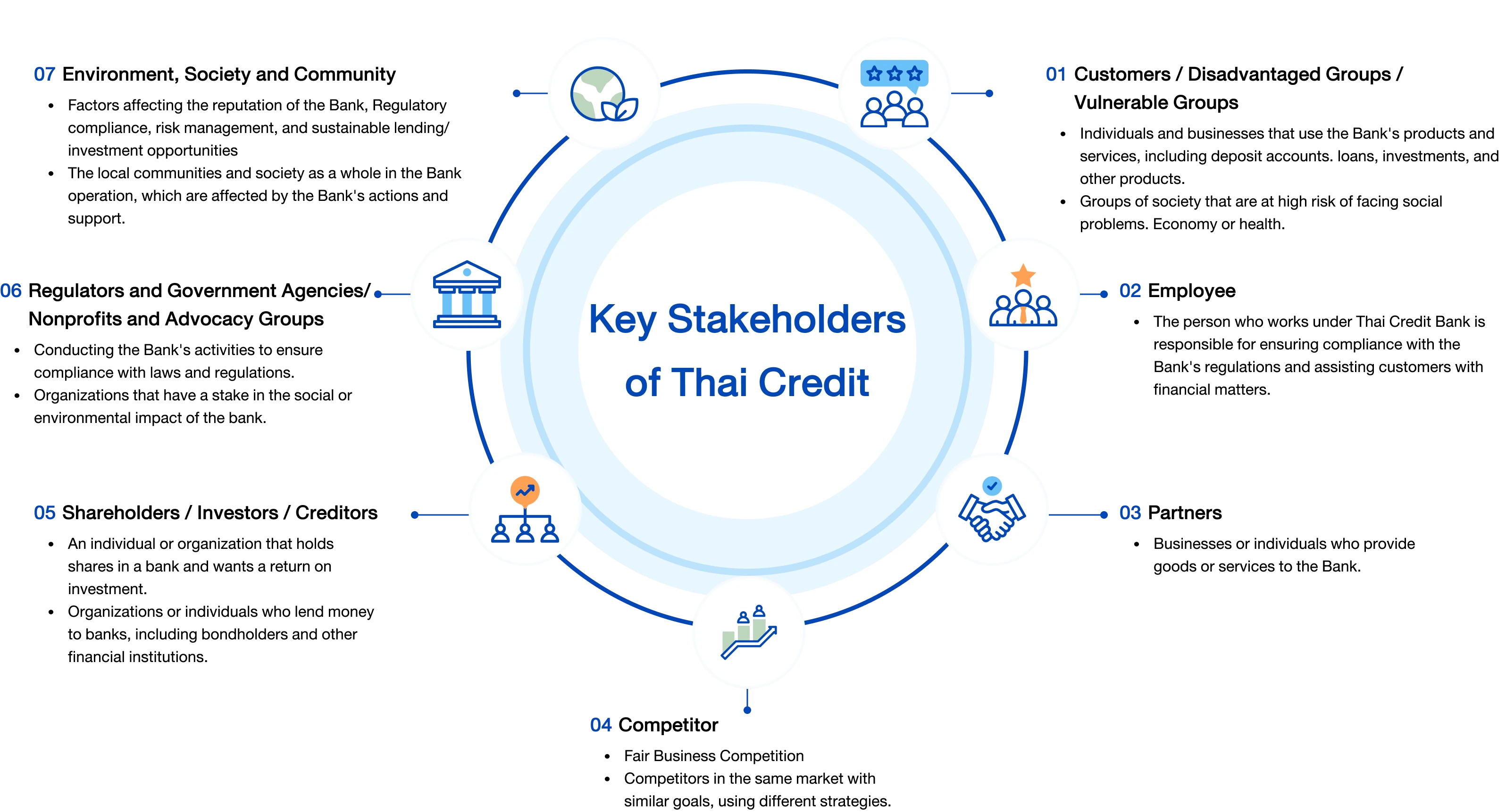
Key stakeholders are divided into 7 groups, consisting of:
 Customers / Underserved and Vulnerable Groups
Individuals and businesses who use the Bank’s products and services, including deposit accounts, loans, investments, and other financial products. This group also includes members of society who are at higher risk of facing social, economic, or health-related challenges.
 Employees
Individuals working within Thai Credit Bank who are responsible for carrying out the Bank’s operations, ensuring compliance with the Bank’s regulations, and supporting customers in accessing financial services
 Suppliers
Businesses or individuals that provide goods or services to the Bank.
 Competitors
Market participants operating within the same industry and pursuing similar objectives, competing under fair business practices while employing different strategies.
 Shareholders / Investors / Creditors
Individuals or organizations holding shares in the Bank and seeking returns on their investments, as well as entities that provide financing to the Bank, including bondholders and other financial institutions.
 Regulators and Government Agencies / Non-Profit and Policy Advocacy Organizations
Regulatory and government bodies overseeing the Bank’s operations to ensure compliance with laws and regulations, as well as organizations concerned with the social or environmental impacts of the Bank’s activities.
 Environment, Society, and Communities
Factors related to environmental, social, and community impacts that influence the Bank’s reputation, regulatory compliance, risk management, and opportunities for sustainable lending and investment.